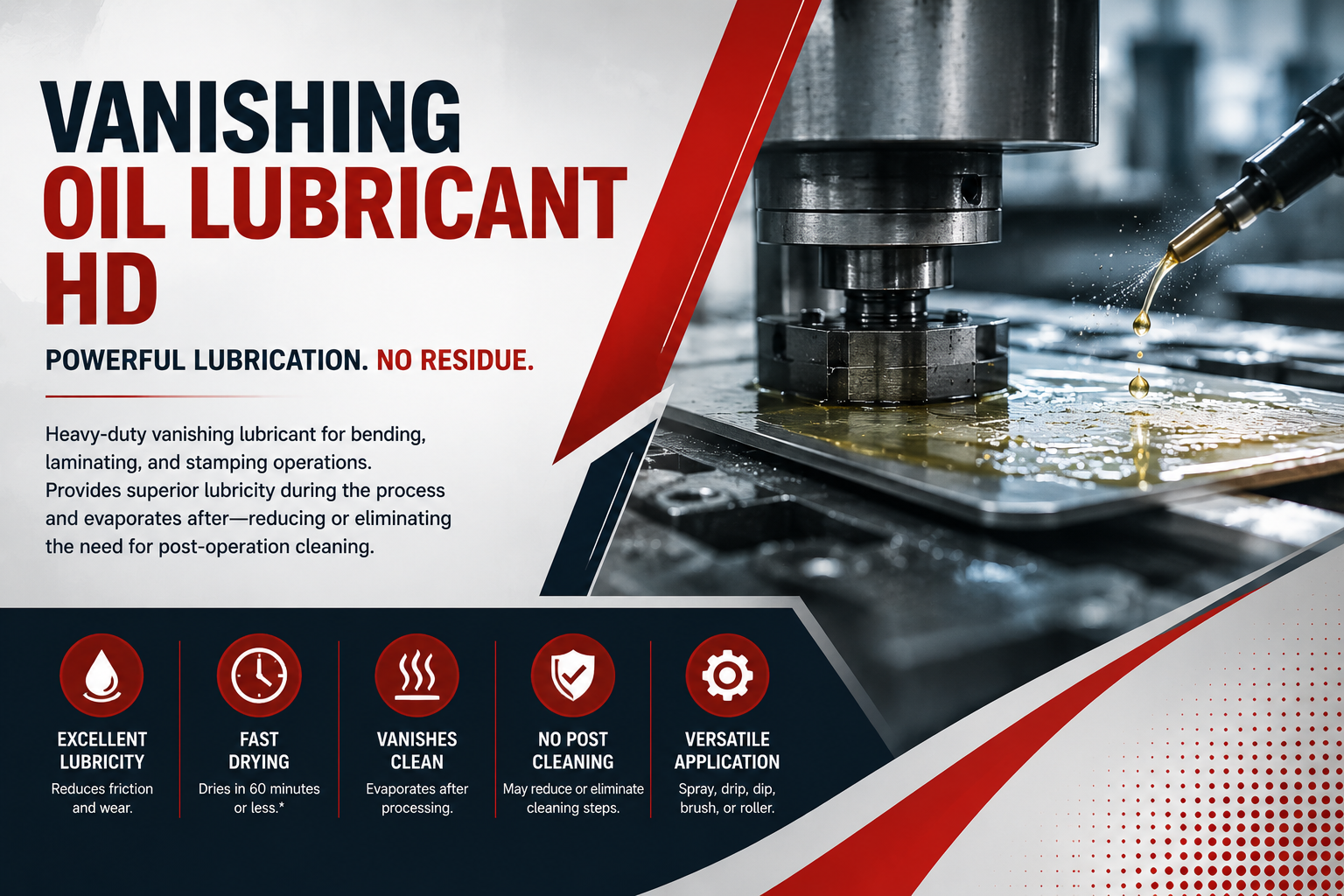
Metal forming operations create a difficult lubrication challenge.
During stamping, bending, laminating, and other forming processes, enough lubrication is needed to reduce friction between the tooling and metal surface. But after the operation is complete, manufacturers may be left with another problem: oil residue on the finished part.
Traditional forming lubricants can require a separate cleaning process before parts can be handled, packaged, stored, or moved to the next production stage.
Vanishing Oil Lubricant HD provides a different approach. It is a low-viscosity, heavy-duty vanishing lubricant designed to provide temporary lubrication during metalworking operations and then gradually evaporate, potentially reducing or eliminating post-operation cleaning when process conditions allow.
For high-volume manufacturing operations, that can mean fewer process steps, lower lubricant consumption, and cleaner finished components.
What Is Vanishing Oil?
Vanishing oil is a temporary metalworking lubricant designed to provide lubrication during forming operations and leave minimal residue afterward.
Unlike conventional oils intended to remain on equipment or components for extended periods, the carrier portion of a vanishing lubricant evaporates after application.
This makes vanishing lubricants particularly useful when manufacturers need lubrication during processing but do not necessarily want a persistent oily film afterward.
Typical applications include:
- Metal stamping
- Bending
- Laminating
- Light-to-heavy forming operations
- Press operations
- Fabrication of metal components
Vanishing Oil Lubricant HD can be used on both ferrous and non-ferrous metals where appropriate for the process.
Why Use a Vanishing Lubricant Instead of Conventional Forming Oil?
The important difference happens after the metalworking operation.
A conventional forming lubricant may continue to coat the component after stamping or bending. Depending on the next manufacturing step, that lubricant may have to be removed.
That potentially introduces additional operations such as:
Forming → Cleaning → Drying → Handling/Packaging
A suitable vanishing lubricant can simplify the process:
Apply → Form → Allow to Dry/Evaporate → Next Process
When the remaining film can be allowed to evaporate before shipping or further processing, the need for post-operation cleaning may be reduced or eliminated.
This can be especially valuable in high-volume manufacturing environments where every additional production step consumes labor, equipment capacity, chemicals, water, and time.
How Does Vanishing Oil Work?
Vanishing lubricants combine temporary lubrication with controlled evaporation.
During the forming operation, the lubricant creates a lubricating film between the tooling and metal surface. This helps reduce friction as the metal is stamped, bent, drawn, or otherwise formed.
After processing, the volatile portion gradually evaporates.
Vanishing Oil Lubricant HD is designed with a typical dry time of 60 minutes or less, although actual drying time depends on operating and environmental conditions.
Factors that can influence evaporation include:
- Amount of lubricant applied
- Ambient temperature
- Air movement
- Part geometry
- Metal surface
- Production environment
- Application method
This is why manufacturers should evaluate drying behavior under their actual production conditions rather than relying only on a theoretical drying time.
The Hidden Cost of Over-Lubricating Metal Parts
More lubricant does not necessarily mean better manufacturing performance.
Excessive lubricant application can create several problems:
- Higher lubricant consumption
- Increased carry-off on finished parts
- Longer drying time
- More residue
- Additional housekeeping
- Increased cleaning requirements
- Higher operating costs
Vanishing Oil Lubricant HD has low viscosity, allowing relatively light and controlled application.
The goal is to provide sufficient lubrication at the tooling interface without unnecessarily flooding the component.
For high-volume stamping operations, even a small reduction in lubricant consumption per component can become significant across thousands or millions of parts.
Heavy-Duty Lubricity Without a Heavy Residual Film
Some vanishing lubricants are designed primarily around rapid evaporation.
However, demanding forming operations may require greater lubricity to protect tooling and provide consistent metal movement.
Vanishing Oil Lubricant HD contains a higher level of lubricity agent than a typical vanishing-type product, making it suitable for more demanding forming operations where additional lubrication is required.
This helps provide the balance manufacturers often need:
Lubrication during forming + reduced residual oil afterward.
Where Vanishing Oil Lubricant HD Can Be Used
Metal Stamping
During stamping, metal moves rapidly between dies while experiencing substantial localized pressure.
A vanishing lubricant helps reduce friction between:
- Sheet metal
- Dies
- Punches
- Forming surfaces
After stamping, the lubricant can evaporate while components wait for handling or shipment.
Metal Bending
Bending creates concentrated friction where the workpiece contacts the tooling.
Proper lubrication can help promote smoother metal movement while reducing friction at contact surfaces.
Vanishing lubricants are particularly useful when manufacturers want lubrication during bending without leaving components heavily coated afterward.
Laminating Operations
During metal laminating and related production processes, controlled lubrication can help maintain smooth processing while limiting excess lubricant carry-off.
Low viscosity also makes controlled application easier.
High-Volume Press Operations
Production lines manufacturing large quantities of similar components can particularly benefit from vanishing lubricants.
Reducing lubricant consumption or eliminating a separate cleaning operation can have a significant cumulative effect on production efficiency.
Ferrous vs. Non-Ferrous Metals
Vanishing Oil Lubricant HD is intended for use with both ferrous and non-ferrous metals.
Ferrous materials may include:
- Carbon steel
- Mild steel
- Other iron-containing alloys
Non-ferrous materials may include:
- Aluminum
- Copper
- Brass
- Other non-iron metals
Because surface finish, alloy composition, downstream processes, and tooling conditions vary, compatibility should always be evaluated for the specific manufacturing operation.
Multiple Application Methods
One advantage of Vanishing Oil Lubricant HD is flexibility in how it can be applied.
Spray
Useful when controlled coverage across a larger surface is required.
Drip
Allows lubricant to be delivered directly to a specific tooling or contact area.
Dip
Parts or materials can be coated where complete surface coverage is appropriate.
Brush
Useful for manual or lower-volume manufacturing processes.
Roller
Can provide controlled, uniform application across sheet or strip material.
Choosing the correct application method can be just as important as selecting the lubricant itself because application quantity directly influences consumption, lubrication performance, and drying time.
Used Neat - No Dilution Required
Vanishing Oil Lubricant HD is designed to be used as received.
No dilution is required.
This simplifies lubricant preparation and helps operators maintain consistent concentration from one production run to another.
For manufacturing facilities, eliminating mixing can also reduce the possibility of incorrect dilution ratios affecting process performance.
Why Low Viscosity Matters
The low viscosity of Vanishing Oil Lubricant HD serves an important operational purpose.
It allows the lubricant to:
- Spread easily across metal surfaces
- Be applied in controlled quantities
- Reduce excessive lubricant carry-off
- Support lower lubricant consumption
- Evaporate after processing
The result is a lubricant designed around temporary process performance rather than long-term oil retention.
Can Vanishing Oil Eliminate Parts Cleaning?
Potentially - but this depends on the production process.
If components have enough time for the remaining lubricant to evaporate before packaging, shipping, or the next operation, separate cleaning may not be necessary.
This can eliminate or reduce processes involving:
- Solvent cleaning
- Alkaline cleaning
- Washing
- Drying
However, manufacturers should consider what happens after forming.
For example, if a component will immediately undergo a sensitive coating, bonding, painting, welding, or other surface-dependent operation, the required surface condition should be verified first.
If residue does need to be removed, remaining Vanishing Oil Lubricant HD can be cleaned using a suitable solvent or alkaline cleaner.
How Vanishing Lubricants Can Improve Production Efficiency
The value of a vanishing lubricant extends beyond friction reduction.
Consider a production line that stamps thousands of components per shift.
If conventional oil requires every component to pass through a washing operation, the manufacturer must manage:
- Cleaning equipment
- Cleaning chemicals
- Labor
- Energy
- Drying
- Waste handling
- Additional floor space
- Additional production time
If the manufacturing process allows a vanishing lubricant to replace that workflow, the lubricant becomes part of a broader process-efficiency strategy.
That is why lubricant selection should not be evaluated only by the price per gallon.
Manufacturers should consider the total cost of the process.
Vanishing Oil vs. Conventional Forming Oil
| Factor | Vanishing Oil | Conventional Forming Oil |
|---|---|---|
| Primary purpose | Temporary forming lubrication | Forming lubrication |
| Residual film | Designed to minimize after evaporation | Usually remains on component |
| Post-process cleaning | May be reduced or eliminated | Often required depending on process |
| Viscosity | Typically low | Varies considerably |
| Application | Controlled/light application | Application depends on process |
| Best suited for | Operations where clean parts are desirable | Operations where residual oil is acceptable |
Neither lubricant type is universally better. The correct choice depends on the metalworking operation and what happens to the component afterward.
How to Determine Whether Vanishing Oil Is Right for Your Operation
Before switching lubricants, manufacturers should evaluate four areas:
1. Forming severity
Determine how much lubricity the stamping, bending, or forming operation requires.
2. Material compatibility
Evaluate performance with the specific steel, aluminum, copper, brass, or other alloy being processed.
3. Required drying time
Determine how much time exists between forming and the next production stage.
4. Downstream operations
Consider whether components will be painted, welded, bonded, coated, assembled, packaged, or shipped.
A controlled production trial is often the most useful way to determine the correct application rate and verify performance.
Frequently Asked Questions
What is vanishing oil used for?
Vanishing oil provides temporary lubrication during metal stamping, bending, laminating, and forming operations. After processing, much of the lubricant evaporates, leaving minimal residual film.
How long does Vanishing Oil Lubricant HD take to dry?
Dry time is generally 60 minutes or less, depending on application quantity, temperature, airflow, part geometry, and other operating conditions.
Does Vanishing Oil Lubricant HD need to be diluted?
No. It is designed to be used neat, without dilution.
Can vanishing oil be sprayed?
Yes. Vanishing Oil Lubricant HD can be applied by spray, drip, dip, brush, or roller, depending on the manufacturing process.
Does vanishing oil need to be cleaned from the part?
Not necessarily. When sufficient evaporation time is available, post-operation cleaning may not be required. If remaining residue must be removed, it can be cleaned with an appropriate solvent or alkaline cleaner.
Can it be used on aluminum?
The lubricant is intended for both ferrous and non-ferrous metals. Actual compatibility should be verified with the specific alloy, tooling, and downstream manufacturing process.
Why use a heavy-duty vanishing lubricant?
A heavy-duty vanishing lubricant provides additional lubricity for more demanding metal-forming operations while retaining the low-residue advantages associated with vanishing lubricants.
A Different Way to Think About Metalworking Lubrication
The purpose of a forming lubricant is not simply to make metal slippery.
A well-selected lubricant should help optimize the entire manufacturing process—from the moment material enters the press to the point where the finished component moves to its next operation.
Vanishing Oil Lubricant HD is particularly useful where manufacturers need strong temporary lubrication but want to minimize the oil remaining on finished parts.
Its combination of low viscosity, enhanced lubricity, multiple application methods, no required dilution, and controlled evaporation makes it a practical option for stamping, bending, laminating, and other metal-forming operations involving ferrous and non-ferrous materials.
For manufacturers evaluating vanishing oil, the most important question is therefore not simply “Does it lubricate the part?”
It is:
“Can this lubricant remove an unnecessary step from our manufacturing process?”
That is where vanishing lubricants can deliver their greatest operational value.