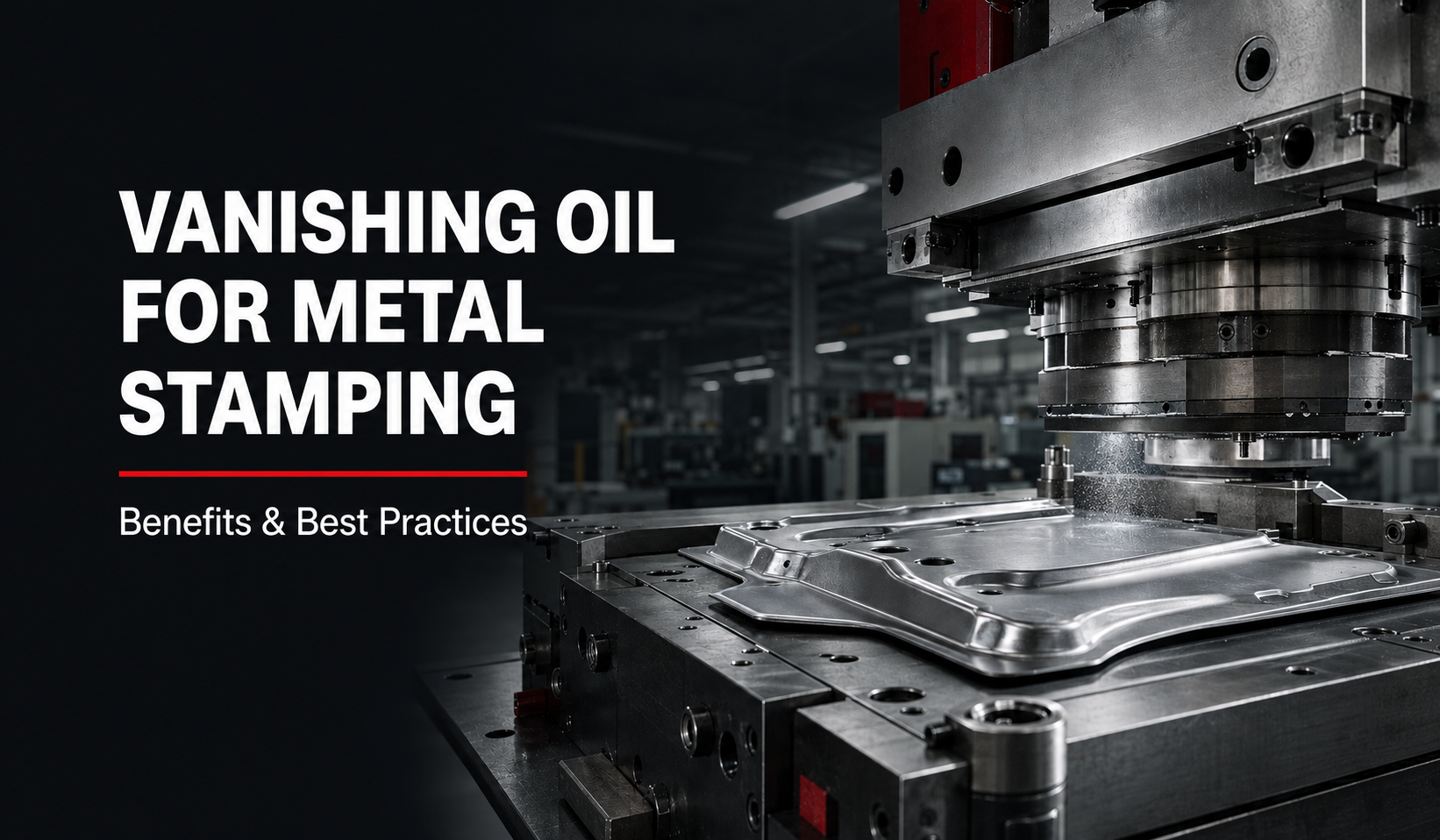
Metal stamping requires enough lubrication to reduce friction and protect the workpiece without leaving excessive oil on the finished component. Conventional stamping oils can provide strong lubrication, but their remaining residue may require an additional cleaning step before parts can be painted, coated, assembled, packaged, or shipped.
Vanishing oil offers a practical alternative for suitable light- to heavy-duty metal-forming operations. It lubricates the metal during stamping and then gradually evaporates, leaving behind little residual film. This can help manufacturers produce cleaner parts, simplify handling, and reduce lubricant consumption.
What Is Vanishing Oil for Metal Stamping?
Vanishing oil is a low-viscosity metalworking lubricant formulated to provide temporary lubrication during operations such as stamping, bending, laminating, blanking, and forming.
Unlike heavier stamping oils that remain on the component, the volatile portion of a vanishing oil evaporates after application. Depending on the formulation, application amount, temperature, airflow, and surrounding conditions, the finished part may become dry or nearly dry to the touch.
Vanishing oil does not literally disappear instantly. It provides lubrication at the tooling and metal interface before gradually evaporating. A small lubricating film may remain, and its compatibility with subsequent operations should always be evaluated.
How Does Vanishing Oil Work During Stamping?
During a metal-stamping operation, friction occurs as the press and tooling cut, bend, punch, or shape the workpiece. Without sufficient lubrication, this friction can contribute to scratching, galling, poor surface quality, accelerated tool wear, and inconsistent part formation.
Vanishing oil creates a thin lubricating layer between the tooling and metal surface. This layer helps the material move through the stamping operation while reducing direct metal-to-metal contact.
After the part leaves the press, the oil begins to evaporate. The drying time will vary according to:
- The amount of lubricant applied
- Ambient temperature
- Air circulation
- Part geometry
- Metal surface condition
- Production speed
- How finished parts are stacked or stored
For Vanishing Oil Lubricant HD, drying generally occurs within 60 minutes or less under suitable conditions.
Benefits of Using Vanishing Oil in Metal Stamping
1. Less Residue on Finished Parts
One of the primary reasons manufacturers select vanishing oil is to produce cleaner components. Because much of the lubricant evaporates, parts are less likely to remain heavily coated with oil after stamping.
This can be especially useful when components must be handled, packaged, stored, or shipped shortly after production.
2. Reduced Post-Operation Cleaning
Traditional stamping lubricants may require solvent cleaning, alkaline washing, or another degreasing process. When vanishing oil is appropriate for the operation and sufficient drying time is available, manufacturers may be able to reduce or eliminate this cleaning step.
Removing an unnecessary cleaning stage can help reduce:
- Labor requirements
- Cleaning-agent consumption
- Water and energy usage
- Work-in-process time
- Part handling
- Production bottlenecks
However, cleaning requirements should be confirmed before painting, coating, welding, bonding, plating, or completing another surface-sensitive process.
3. Lower Lubricant Carry-Off
A low-viscosity vanishing oil can spread across the metal surface without requiring a heavy application. Applying a controlled amount helps reduce the volume of lubricant carried away by finished parts.
Lower carry-off can reduce overall consumption and help keep the stamping area cleaner.
4. Improved Part Handling
Parts covered with conventional stamping oil can be slippery, messy, or difficult to package. Once vanishing oil has adequately evaporated, components may be easier and cleaner to handle.
This is particularly valuable in high-volume operations where stamped parts move quickly from production to inspection, assembly, packaging, or shipping.
5. Suitable for Different Application Methods
Vanishing Oil Lubricant HD is used as received, without dilution. Depending on the production setup, it may be applied using:
- Drip systems
- Spray systems
- Brushes
- Rollers
The best method depends on the shape of the workpiece, production speed, press configuration, and amount of lubrication required.
6. Application on Ferrous and Non-Ferrous Metals
Vanishing Oil Lubricant HD is intended for operations involving ferrous and non-ferrous metals. Potential workpiece materials may include steel, aluminum, copper, and other compatible metals.
A controlled trial should be performed before full production, particularly when working with coated, pre-painted, polished, or appearance-sensitive materials.
Metal-Stamping Applications for Vanishing Oil
Vanishing oil may be considered for several types of stamping and forming operations, including:
- Sheet-metal stamping
- Blanking and punching
- Shallow drawing
- Bending and forming
- Metal laminating
- Fin stamping
- Roll forming
- Tube and component forming
- High-speed progressive stamping
Suitability depends on the severity of the operation. Heavy draws, extreme pressures, difficult alloys, or processes involving high heat may require a lubricant with greater film strength or a specialized metal-forming fluid.
Best Practices for Applying Vanishing Oil
Apply Only the Amount Required
More lubricant does not always provide better results. Excessive application can increase drying time, waste product, create unnecessary mist, and leave more residual film.
Begin with a controlled application and adjust the volume according to part quality, tool condition, and forming performance.
Apply the Lubricant Evenly
Uneven coverage can create areas with insufficient lubrication and other areas with too much oil. Spray nozzles, rollers, or drip systems should be positioned to provide consistent coverage across the working surface.
Regularly inspect the application equipment for clogged nozzles, incorrect flow rates, misalignment, or leakage.
Provide Adequate Drying Time and Airflow
Temperature and ventilation can affect how quickly the lubricant evaporates. Parts stacked tightly together may dry more slowly because air cannot circulate freely around their surfaces.
Production trials should measure actual drying time under normal plant conditions rather than relying on a general estimate.
Monitor Tooling and Part Quality
After introducing a vanishing oil, inspect the operation for:
- Surface scratches
- Galling or metal pickup
- Inconsistent forming
- Tool wear
- Staining
- Remaining residue
- Changes in part dimensions or appearance
These observations can help determine whether the product and application rate are appropriate.
Test Downstream Compatibility
Even when a part appears dry, a small residual film may remain. Before adopting the lubricant throughout the production line, test the finished component with any subsequent operation, including:
- Painting or powder coating
- Adhesive bonding
- Welding
- Plating
- Assembly
- Protective packaging
If cleaning is required, remaining film can generally be removed using a suitable solvent or alkaline cleaner.
Follow the SDS and Plant Safety Procedures
Vanishing oils may contain volatile components. Review the product’s Safety Data Sheet before use and follow all recommendations concerning ventilation, storage, handling, personal protective equipment, ignition sources, and spill control.
When Is Vanishing Oil a Good Choice?
Vanishing oil may be a good option when a stamping operation requires:
- Effective temporary lubrication
- Low lubricant carry-off
- Cleaner finished components
- Fast or controlled evaporation
- Reduced post-operation cleaning
- Low-viscosity application
- Compatibility with ferrous and non-ferrous metals
- Multiple application options
The best way to determine suitability is through a controlled production trial using the actual metal, tooling, application system, production speed, and downstream processes.
Frequently Asked Questions
Does vanishing oil leave the stamped part completely residue-free?
Not necessarily. Most of the volatile carrier evaporates, but a thin lubricating film may remain. The amount of residue depends on the formulation and how much oil is applied.
How long does vanishing oil take to dry?
Drying time varies with application amount, temperature, airflow, part shape, and storage conditions. Vanishing Oil Lubricant HD generally dries within 60 minutes or less under suitable conditions.
Does vanishing oil need to be diluted?
Vanishing Oil Lubricant HD is designed to be used as received and does not require dilution.
Can vanishing oil eliminate parts washing?
It may reduce or eliminate cleaning for some operations, particularly when parts have enough time to dry before handling or shipping. Cleaning may still be necessary before surface-sensitive processes such as painting, coating, plating, or adhesive bonding.
Can vanishing oil be used on aluminum?
It is intended for use on both ferrous and non-ferrous metals. However, compatibility and staining should be tested on the specific aluminum alloy and surface finish before full-scale use.
How can vanishing oil be applied?
Depending on the equipment and operation, it can be applied by spray, drip, brush, or roller.
Is vanishing oil appropriate for every stamping operation?
No. The lubricant must match the metal, forming severity, tooling, operating temperature, production speed, and downstream requirements. Severe drawing or high-load forming may require a heavier-duty or specialized lubricant.
Vanishing Oil Lubricant HD – 55 Gallon Drum
Vanishing Oil Lubricant HD is a low-viscosity, heavy-duty vanishing lubricant developed for stamping, bending, laminating, and other metal-forming operations involving ferrous and non-ferrous metals.
It is used without dilution and may be applied using spray, drip, brush, or roller methods. Its controlled evaporation can help reduce lubricant carry-off and minimize the need for post-operation cleaning when parts have sufficient time to dry.
View Vanishing Oil Lubricant HD – 55 Gallon Drum
For assistance with product selection or application requirements, call 1-855-405-6789
Looking for a Metalworking Fluid for Your Industry?
Whether you manufacture automotive components, HVAC equipment, electrical laminations, appliances, tubing, or other metal products, selecting the right fluid depends on your specific process. Complete the form to tell us about your application and quantity requirements.