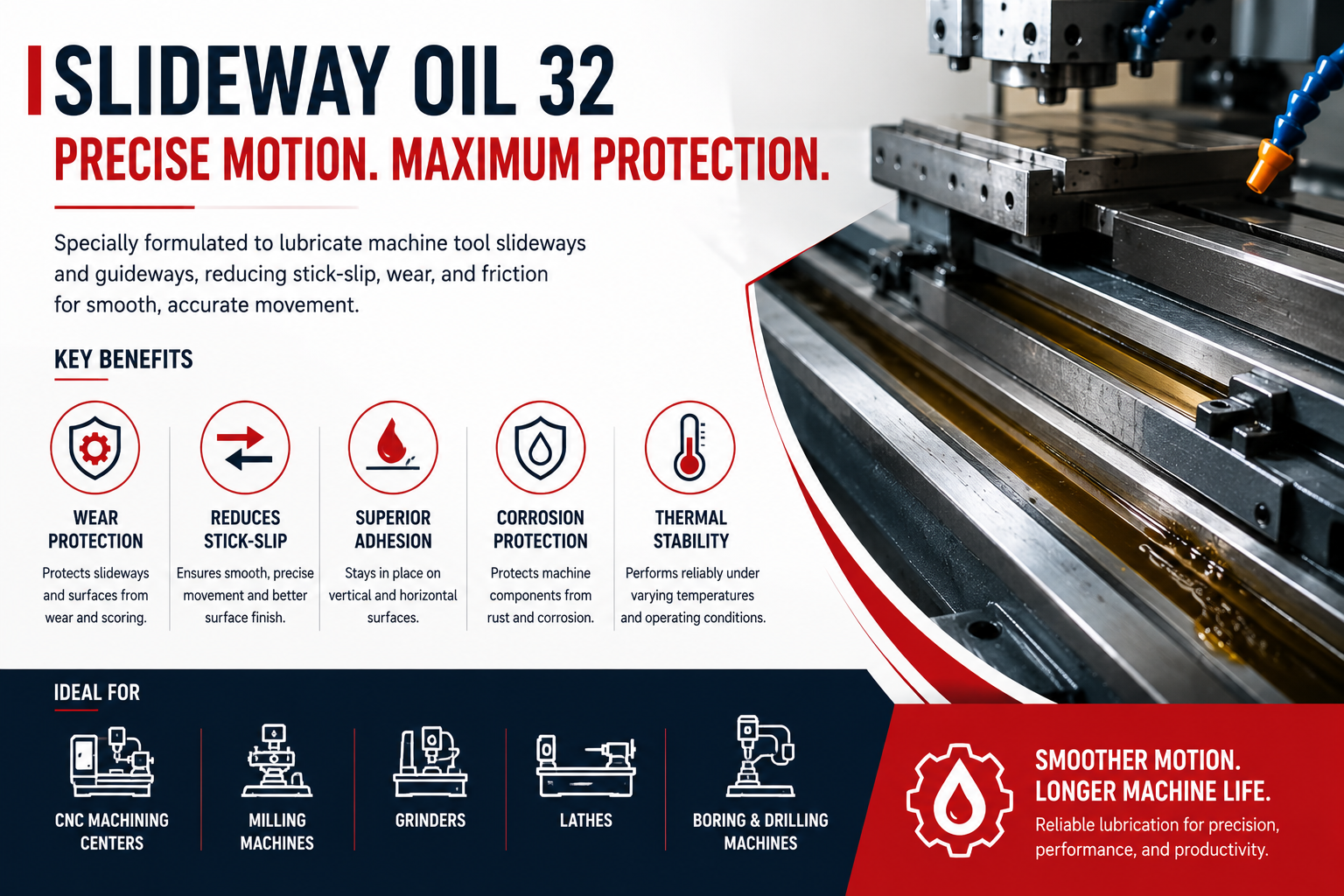
Modern machining centers and precision manufacturing equipment depend on smooth, accurate linear motion. Whether operating a CNC machining center, milling machine, grinder, or lathe, the performance of slideways directly affects machining accuracy, surface finish, and equipment life.
Slideway Oil 32 is specifically formulated to lubricate machine tool slideways while reducing stick-slip, protecting against wear, and maintaining smooth table movement. Unlike general hydraulic or machine oils, slideway lubricants are engineered to remain on vertical and horizontal guideways while providing consistent lubrication under slow-moving, high-load conditions.
Choosing the correct slideway oil helps manufacturers improve machining precision, reduce maintenance, and extend machine life.
What Is Slideway Oil 32?
Slideway Oil 32 is a specialized lubricant designed for the guideways, slides, and linear moving surfaces of machine tools.
Its primary functions include:
- Lubricating machine guideways
- Preventing stick-slip movement
- Reducing friction and wear
- Protecting against corrosion
- Maintaining positioning accuracy
- Resisting wash-off from metalworking fluids
Unlike conventional lubricants, slideway oils contain additives that improve adhesion, allowing the lubricant to remain on guide surfaces even during continuous operation.
Why Machine Tool Guideways Need Specialized Lubrication
Guideways operate differently from bearings or gears.
They move slowly while supporting heavy machine loads and require extremely smooth, controlled motion. Standard oils may not provide adequate adhesion or friction characteristics, resulting in inconsistent movement.
A dedicated slideway oil helps:
- Maintain a stable lubricating film
- Reduce friction during slow movement
- Improve positioning accuracy
- Protect precision-machined guide surfaces
- Minimize wear over long operating periods
Proper guideway lubrication contributes directly to machining quality and machine reliability.
What Is Stick-Slip and Why Does It Matter?
One of the primary reasons for using slideway oil is to prevent stick-slip, a condition where machine components alternate between sticking and suddenly slipping during movement.
Stick-slip can cause:
- Poor surface finish
- Inaccurate machining
- Vibration
- Jerky table movement
- Increased guideway wear
- Reduced machining precision
Slideway Oil 32 is formulated with friction modifiers that help produce smooth, controlled movement across guide surfaces.
Applications for Slideway Oil 32
Slideway Oil 32 is commonly used on precision machine tools throughout industrial manufacturing.
Typical applications include:
CNC Machining Centers
Lubricates:
- Linear guideways
- Machine tables
- Cross slides
- Feed systems
Milling Machines
Provides lubrication for:
- Knee slides
- Table guideways
- Saddle assemblies
Surface and Cylindrical Grinders
Helps maintain:
- Smooth table travel
- Consistent positioning
- Reduced guideway wear
Engine Lathes
Protects:
- Bed ways
- Carriage slides
- Compound slides
- Tailstock guideways
Boring and Drilling Machines
Lubricates:
- Moving columns
- Sliding tables
- Guide rails
Why ISO VG 32 Is Commonly Used
ISO VG 32 provides a relatively light viscosity that allows rapid distribution while maintaining sufficient lubrication for many high-speed or lightly loaded guideway systems.
Benefits include:
- Smooth lubricant circulation
- Good film strength
- Reliable wear protection
- Reduced operating resistance
- Improved machine efficiency
The correct viscosity should always match the machine manufacturer's recommendation.
Resistance to Metalworking Fluids
Machine tools frequently operate with coolants and cutting fluids.
Ordinary oils may be washed away or emulsify with coolant, reducing lubrication effectiveness.
Slideway Oil 32 is formulated to:
- Resist coolant contamination
- Maintain lubrication on guideways
- Reduce oil wash-off
- Improve lubrication consistency
This helps extend lubricant life while protecting machine components.
Components Protected by Slideway Oil
Proper guideway lubrication protects:
- Linear guideways
- Machine beds
- Cross slides
- Carriage assemblies
- Machine tables
- Feed mechanisms
- Guide rails
- Sliding columns
Maintaining proper lubrication helps preserve machining accuracy and extend machine service life.
Common Causes of Guideway Wear
Several factors contribute to premature slideway wear.
Insufficient Lubrication
Lack of oil increases friction and accelerates wear.
Coolant Contamination
Coolant can dilute lubrication if improper oil is used.
Dirt and Metal Particles
Contaminants increase abrasive wear.
Incorrect Oil Viscosity
Using the wrong viscosity may reduce lubrication performance.
Poor Maintenance
Irregular lubrication schedules increase component wear.
Best Practices for Machine Tool Lubrication
To maximize guideway performance:
- Use the OEM-recommended slideway oil viscosity.
- Keep lubrication systems clean.
- Inspect lubrication lines regularly.
- Remove excess chips from guideways.
- Monitor oil condition.
- Prevent coolant contamination whenever possible.
- Follow scheduled maintenance intervals.
Proper maintenance helps preserve machine accuracy over many years of operation.
Industries That Commonly Use Slideway Oil 32
Slideway Oil 32 is widely used across industries that rely on precision machining, including:
- Aerospace manufacturing
- Automotive manufacturing
- Tool and die shops
- Metal fabrication
- General machining
- CNC production facilities
- Industrial maintenance workshops
- Precision engineering
Slideway Oil 32 Compared to Other Guideway Oils
| Viscosity Grade | Typical Applications |
|---|---|
| ISO VG 32 | High-speed or lightly loaded guideways and precision machine tools |
| ISO VG 68 | Medium-duty machine tool guideways |
| ISO VG 220 | Heavy-duty vertical guideways and large machine tools |
The appropriate viscosity depends on the machine manufacturer's lubrication requirements.
Frequently Asked Questions
What is Slideway Oil 32 used for?
Slideway Oil 32 is used to lubricate the guideways and sliding surfaces of machine tools, helping reduce friction, prevent stick-slip, and maintain machining accuracy.
Can hydraulic oil replace slideway oil?
Hydraulic oil is generally not recommended as a substitute because it does not contain the friction modifiers and tackiness additives required for guideway lubrication. Always follow the equipment manufacturer's recommendations.
What causes stick-slip on machine tools?
Stick-slip occurs when friction causes guideway surfaces to alternate between sticking and suddenly moving. Proper slideway oil helps maintain smooth, controlled movement.
Is Slideway Oil 32 suitable for CNC machines?
Yes, when the machine manufacturer specifies ISO VG 32 guideway oil. It is commonly used in CNC machining centers, milling machines, grinders, and other precision equipment.
How often should slideway oil be replaced?
Replacement intervals depend on machine usage, operating environment, and the manufacturer's maintenance schedule. Regular inspection of lubrication systems is recommended.
Choosing the Right Slideway Oil
When selecting guideway oil, consider:
- Machine manufacturer recommendations
- Guideway design
- Operating speed
- Load conditions
- Lubrication system type
- Coolant compatibility
- Maintenance schedule
Using the correct slideway oil helps maintain precision, reduce wear, and support reliable long-term machine performance.
Slideway Oil 32 is engineered to provide dependable lubrication for machine tool guideways operating under precision conditions. Its specialized formulation helps reduce stick-slip, protect sliding surfaces, resist coolant contamination, and maintain accurate machine movement.
For CNC machines, milling machines, grinders, lathes, and other precision equipment, selecting the correct guideway oil and following proper maintenance practices can improve machining quality, reduce downtime, and extend the service life of valuable machine tools.