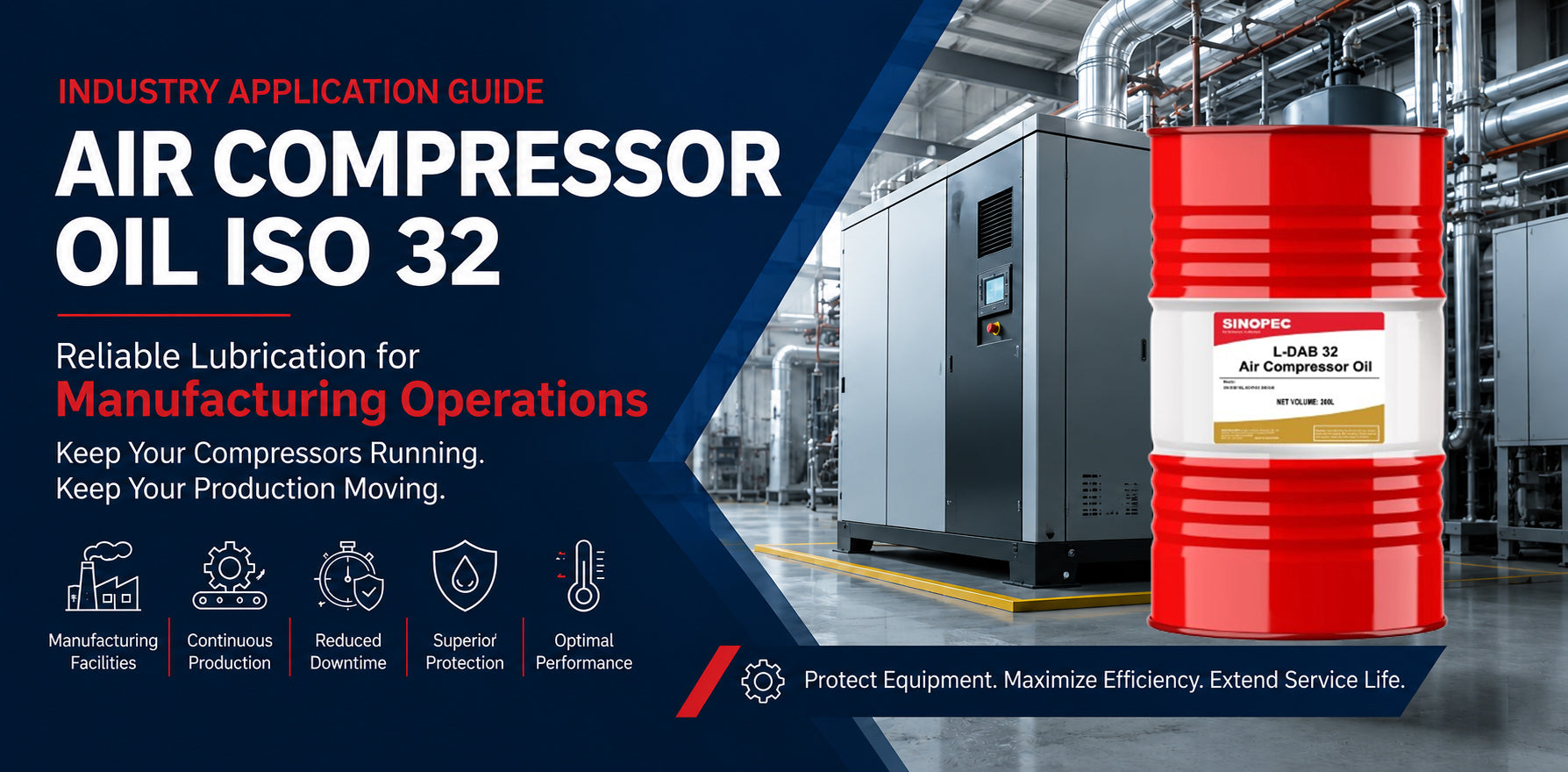
In manufacturing facilities, compressed air is often called the fourth utility, alongside electricity, water, and natural gas. It powers production lines, packaging equipment, robotic systems, pneumatic tools, and automated machinery. A single compressor failure can interrupt an entire production process, making lubrication an important part of plant reliability rather than just routine maintenance.
Why Manufacturing Plants Usually Prefer ISO 32 Compressor Oil
Many manufacturing plants operate rotary screw compressors for long production shifts or even 24/7. Under these conditions, the lubricant performs several critical functions simultaneously:
- Lubricates bearings and rotating components
- Removes heat generated during compression
- Creates an effective seal between the rotors
- Helps suspend contaminants until filtration
- Protects against oxidation and varnish formation
Unlike many industrial oils, compressor oil is exposed to continuous high temperatures and compressed air, making oxidation resistance one of its most important characteristics.
Why ISO 32 Is Common in Manufacturing
ISO VG 32 viscosity is commonly selected for compressors operating in:
- Climate-controlled factories
- Electronics manufacturing
- General industrial production
- Automotive assembly
- Packaging facilities
- Textile manufacturing
The relatively lower viscosity helps maintain good oil circulation during startup while providing reliable lubrication once the compressor reaches operating temperature.
(Note: Always follow the compressor OEM recommendation.)
The Hidden Cost of Poor Compressor Lubrication
Many plants focus on replacing filters and separators but overlook lubricant condition.
As compressor oil ages, oxidation can produce varnish deposits that may:
- Restrict oil passages
- Increase discharge temperatures
- Reduce cooling efficiency
- Cause sticking of internal components
- Shorten bearing and airend life
Varnish is one of the leading causes of reliability issues in oil-injected rotary screw compressors, making oil condition monitoring just as important as scheduled oil changes.
Industries That Commonly Use ISO 32 Air Compressor Oil
Instead of listing equipment, explain why each industry depends on reliable compressed air.
| Industry | Typical Air-Powered Applications |
|---|---|
| Automotive Manufacturing | Robotic assembly, paint systems, pneumatic tools |
| Metal Fabrication | CNC machines, laser cutting support, pneumatic cylinders |
| Food Packaging* | Packaging equipment and conveyors (oil selection depends on air quality requirements) |
| Textile Manufacturing | Air jets, looms, pneumatic actuators |
| Plastic Processing | Injection molding equipment and automation |
| Electronics Assembly | Precision pneumatic handling systems |
Maintenance Practices That Reduce Downtime
A well-maintained lubricant system can improve compressor reliability.
Recommended practices include:
- Monitor operating temperature trends.
- Check oil level regularly.
- Replace filters at scheduled intervals.
- Perform periodic oil analysis.
- Investigate any increase in discharge temperature.
- Keep oil coolers clean to maintain heat transfer efficiency.
Laboratory oil analysis is widely recommended because it can identify oxidation, contamination, and lubricant degradation before they lead to equipment failure.
Choosing the Right Compressor Oil
When selecting compressor oil, don't focus on viscosity alone. Consider:
- Compressor type (rotary screw or reciprocating)
- Ambient operating temperature
- Duty cycle
- Recommended drain interval
- OEM viscosity specification
- Oxidation resistance
- Deposit control characteristics

FAQs
Is ISO 32 compressor oil suitable for rotary screw compressors?
Many oil-injected rotary screw compressors use ISO VG 32 oil where recommended by the equipment manufacturer.
Can ISO 32 be used in reciprocating compressors?
Some reciprocating compressors specify ISO 32, while others require different viscosities. Always follow the OEM recommendation.
What causes compressor oil to form varnish?
High operating temperatures, oxidation, long oil drain intervals, contamination, and poor-quality lubricants all contribute to varnish formation.
How often should compressor oil be tested?
Many industrial facilities include lubricant analysis as part of predictive maintenance, with testing intervals based on operating hours and equipment criticality.