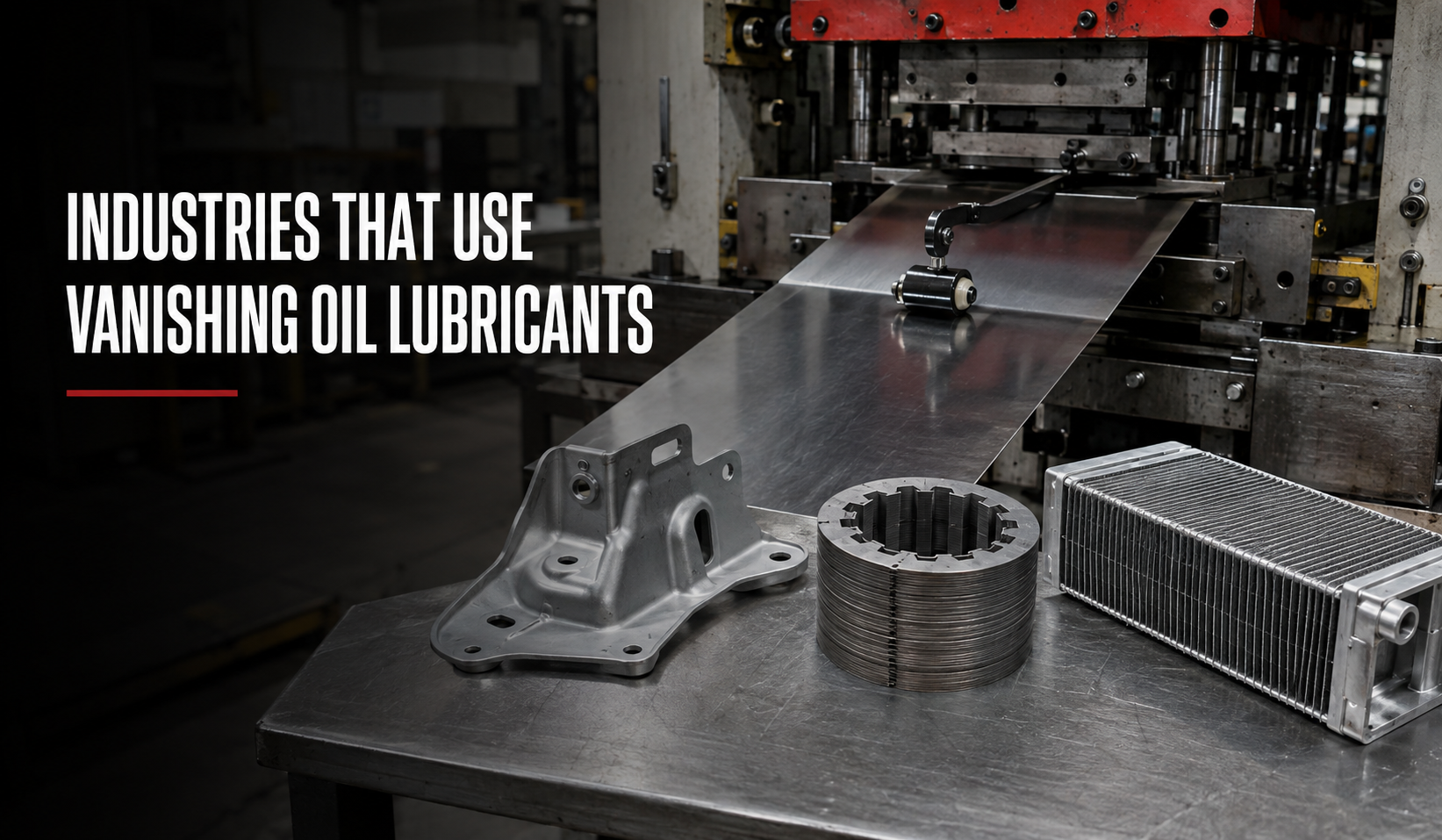
Vanishing oil lubricants are used across manufacturing sectors that produce metal components through stamping, bending, blanking, laminating, punching, and roll forming.
These industries often share one production requirement: the metal needs lubrication while it is being formed, but the finished component should not remain covered with a heavy oil film.
Common users include automotive component manufacturers, HVAC producers, electrical lamination manufacturers, appliance factories, building-product manufacturers, tube fabricators, hardware producers, and contract metal stampers.
Industry and Application Overview
| Industry | Example components | Common operations |
|---|---|---|
| Automotive and transportation | Brackets, shields, clips, panels and supports | Stamping, blanking and forming |
| HVAC and refrigeration | Heat-exchanger fins, brackets and housings | High-speed fin stamping and punching |
| Electrical equipment | Motor and transformer laminations | Precision blanking and lamination stamping |
| Appliance manufacturing | Panels, frames, brackets and internal supports | Stamping, bending and roll forming |
| Construction products | Gutters, flashing, channels and trim | Roll forming and bending |
| Tube and pipe fabrication | Tubing, sleeves and formed sections | Tube bending, sizing and forming |
| Hardware and metal furniture | Hinges, clips, shelving and decorative parts | Punching, embossing and stamping |
| Contract metal stamping | Custom components for multiple markets | Progressive stamping and blanking |
1. Automotive and Transportation Components
Automotive manufacturers and their suppliers produce large quantities of stamped metal components. While major structural parts may require heavy-duty drawing compounds, many smaller or less severe components can be candidates for a vanishing lubricant.
Examples include:
- Mounting brackets
- Retaining clips
- Heat shields
- Covers
- Reinforcement plates
- Electrical housings
- Light-gauge supports
- Interior metal components
These parts may move through several production stages in a short period. After stamping, they might be inspected, welded, assembled, coated, placed into returnable containers, or shipped to another facility.
A heavy oil film can transfer from the component to gloves, packaging, conveyors, and inspection equipment. A properly selected vanishing lubricant can reduce this transfer by leaving a lighter surface after evaporation.
Automotive suppliers must still confirm compatibility with welding, adhesives, coatings, and customer cleanliness specifications. A component that appears dry may retain a small amount of performance additive.
2. HVAC and Refrigeration Manufacturing
HVAC manufacturing is one of the most recognized markets for vanishing lubricants, particularly in high-speed production of thin metal components.
Common applications include:
- Aluminum heat-exchanger fins
- Copper and aluminum components
- Ventilation-system brackets
- Duct fittings
- Equipment housings
- Fan and blower components
- Refrigeration cabinet parts
Heat-exchanger fins are manufactured from very thin metal and are often stamped at high speeds. The lubricant must spread across the material without creating a heavy coating that attracts dirt, interferes with handling, or leaves the finished assembly visibly oily.
The thin geometry of HVAC fins also makes excessive lubricant undesirable. Oil trapped between closely spaced fins may take longer to evaporate and can collect dust during storage.
Manufacturers should therefore evaluate evaporation under actual stacking and assembly conditions—not only on a flat test panel.
3. Electric Motor and Transformer Lamination Manufacturing
Motors, generators, and transformers use stacks of thin electrical-steel laminations. These laminations are precisely blanked or stamped before being assembled into a core.
Typical components include:
- Motor stator laminations
- Motor rotor laminations
- Transformer core laminations
- Generator components
- Small electromagnetic assemblies
Dimensional consistency is especially important because many individual laminations may be stacked together. Excessive oil between layers can complicate handling, interfere with stacking, or contaminate assembly equipment.
A low-viscosity vanishing lubricant can provide temporary lubrication during punching or blanking while limiting the amount of fluid carried into the stacking process.
However, the lubricant must be tested with the steel’s insulating coating. Electrical steel may arrive with a specialized surface treatment, and the selected fluid should not stain, soften, or otherwise affect that coating.
4. Appliance Manufacturing
Household and commercial appliances contain numerous stamped and formed metal parts. Manufacturers may process cold-rolled steel, galvanized steel, stainless steel, aluminum, and pre-painted sheet.
Potential applications include:
- Washer and dryer panels
- Refrigerator components
- Oven and range housings
- Dishwasher panels
- Air-conditioner cabinets
- Internal brackets and supports
- Equipment covers and frames
Many appliance components are appearance-sensitive. Scratches, oil stains, fingerprints, and surface contamination can create cosmetic defects or interfere with painting and assembly.
Vanishing oil may be considered for forming pre-painted or finished metal because it can provide lubrication without leaving the same heavy coating associated with conventional forming oil.
Compatibility trials are essential. The lubricant should be tested on the actual coating or finish, including the required drying period, stacking arrangement, packaging material, and storage temperature.
5. Building Products and Architectural Components
Building-product manufacturers use roll-forming and bending equipment to convert metal coils into long, consistent profiles.
Examples include:
- Aluminum gutters
- Roof flashing
- Metal channels
- Trim sections
- Siding accessories
- Ceiling-grid components
- Light framing components
- Decorative architectural profiles
Many of these products are manufactured from galvanized, painted, or coated metal. Their long surfaces must pass through multiple rollers without scratching or sticking.
Vanishing oil can help reduce friction during forming while limiting the oily surface that remains on completed sections. This is valuable when products are bundled, wrapped, boxed, or handled during installation.
The application rate should be controlled carefully. Excess fluid can collect between nested profiles, slow evaporation, and affect packaging.
6. Tube and Pipe Fabrication
Tube manufacturers and fabricators form metal into components for automotive systems, furniture, appliances, HVAC equipment, and general industrial use.
Potential operations include:
- Tube bending
- Light tube forming
- Sizing
- End forming
- Roll forming
- Shallow shaping
- Forming of sleeves and cylindrical sections
A lubricant used on the exterior of a tube can easily transfer to tooling, clamps, storage racks, and packaging. Low-residue lubrication may help simplify handling after suitable bending and forming operations.
Tube geometry introduces an important consideration: fluid can collect inside bends, seams, or hollow sections. Evaporation from an enclosed area will usually be slower than evaporation from an open sheet.
Manufacturers should inspect both the outside and inside of the tube during a product trial. Severe mandrel bending or difficult alloys may require a heavier lubricant, paste, or specialized bending gel instead of a vanishing oil.
7. Hardware, Shelving, and Metal Furniture
Hardware and metal-furniture factories manufacture large quantities of relatively small stamped components.
Examples include:
- Hinges
- Clips
- Brackets
- Fastening components
- Shelving supports
- Drawer components
- Furniture frames
- Decorative brass and copper trim
These parts may be punched, embossed, bent, or stamped before going directly to assembly or packaging. A heavy residual oil can make small components difficult to count, sort, coat, package, or handle.
Decorative components present an additional challenge because surface appearance is part of the finished product. A lubricant should provide adequate tool and surface protection without staining brass, copper, aluminum, or coated steel.
For small parts packed in bulk, sufficient drying time is important. Parts placed together too quickly may trap fluid between their surfaces.
8. Contract Metal Stamping and Fabrication
Contract stampers manufacture parts for multiple customers and industries. A single facility may process aluminum in one production run, galvanized steel in another, and copper alloys in the next.
Vanishing oil may provide value when a contract manufacturer needs:
- Broad compatibility across different metals
- Cleaner finished parts
- Reduced lubricant transfer between operations
- Easier packaging and customer delivery
- A ready-to-use fluid for individual machines
- Less carry-off on high-volume jobs
However, customer requirements can vary considerably. One customer may permit a light residual film, while another may specify a particular level of surface cleanliness.
Contract manufacturers should document the approved lubricant, application rate, drying conditions, and cleaning requirements for every part number rather than applying one general standard to all jobs.
What Do These Industries Have in Common?
The industries are different, but their reasons for evaluating vanishing oil are often similar.
High Production Volume
When thousands of parts are produced every shift, even a small amount of unnecessary lubricant carry-off can increase consumption, housekeeping, and handling requirements.
Thin or Appearance-Sensitive Metal
Thin sheet, pre-painted metal, polished components, and decorative alloys require enough lubrication to protect the surface without creating visible staining or a persistent oily finish.
Rapid Movement Between Operations
Components may move directly from forming to assembly, inspection, stacking, or packaging. A lighter residual film can simplify this production flow.
Multiple Materials
Manufacturers frequently process carbon steel, galvanized steel, aluminum, copper, or brass. Multi-metal compatibility can reduce the need to store a separate lubricant for every material, provided each application has been validated.
Clean Packaging and Customer Delivery
Finished parts may need to arrive without oily cartons, stained dividers, or excessive lubricant transfer. Low carry-off can be as important to the customer experience as it is to factory housekeeping.
How to Determine Whether an Industry Application Is Suitable
Industry alone does not determine whether vanishing oil is the correct lubricant. Two manufacturers in the same sector can have completely different operating conditions.
Evaluate the individual application based on:
- Metal type and surface treatment
- Material thickness
- Part geometry
- Forming pressure and severity
- Press or line speed
- Tooling design
- Required surface finish
- Time available for evaporation
- Part stacking and packaging method
- Welding, coating, bonding, or assembly requirements
- Storage duration
- Customer cleanliness specifications
A controlled production trial should reproduce the complete manufacturing process, including downstream handling—not only the forming operation.
Frequently Asked Questions
Which industry uses vanishing oil most commonly?
Vanishing lubricants are commonly associated with metal stamping, HVAC fin production, roll forming, appliance components, electrical laminations, and other operations involving thin or appearance-sensitive metals.
Can vanishing oil be used when manufacturing electrical laminations?
Potentially, yes. The lubricant must be tested for compatibility with the electrical steel and its insulating surface coating. Residue and stacking behavior should also be evaluated.
Is vanishing oil suitable for pre-painted metal?
Some vanishing lubricants are used on pre-painted aluminum and steel. Compatibility should be confirmed using the actual paint system because formulations and coatings vary.
Can tube manufacturers use vanishing oil?
It may be suitable for certain bending and forming operations. Severe tube bending may require a specialized lubricant or bending gel with greater film strength.
Is vanishing oil only used for aluminum?
No. Depending on the formulation, it may be used on ferrous and non-ferrous metals, including carbon steel, galvanized steel, aluminum, copper, and brass.
Can the same vanishing oil be used throughout an entire factory?
Not necessarily. Every operation should be assessed according to its load, metal, tooling, finish, and downstream requirements. One product may work for several lines but not for every process.
Vanishing Oil Lubricant HD for Industrial Metal Forming
Vanishing Oil Lubricant HD is intended for bending, laminating, stamping, and related operations involving ferrous and non-ferrous metals.
Its low viscosity helps limit excessive carry-off, while its evaporation characteristics can support cleaner part handling when sufficient drying time is available.
View Vanishing Oil Lubricant HD – 55 Gallon Drum
For help evaluating your industrial application, call 1-855-405-6789
Not Sure Which Lubricant Type Is Right for Your Operation?
Tell us about your metal, manufacturing process, package-size requirements, and usage frequency. Our team will review the information and help determine whether a vanishing oil or another metalworking fluid is more suitable.
Get a Metalworking Fluid Recommendation