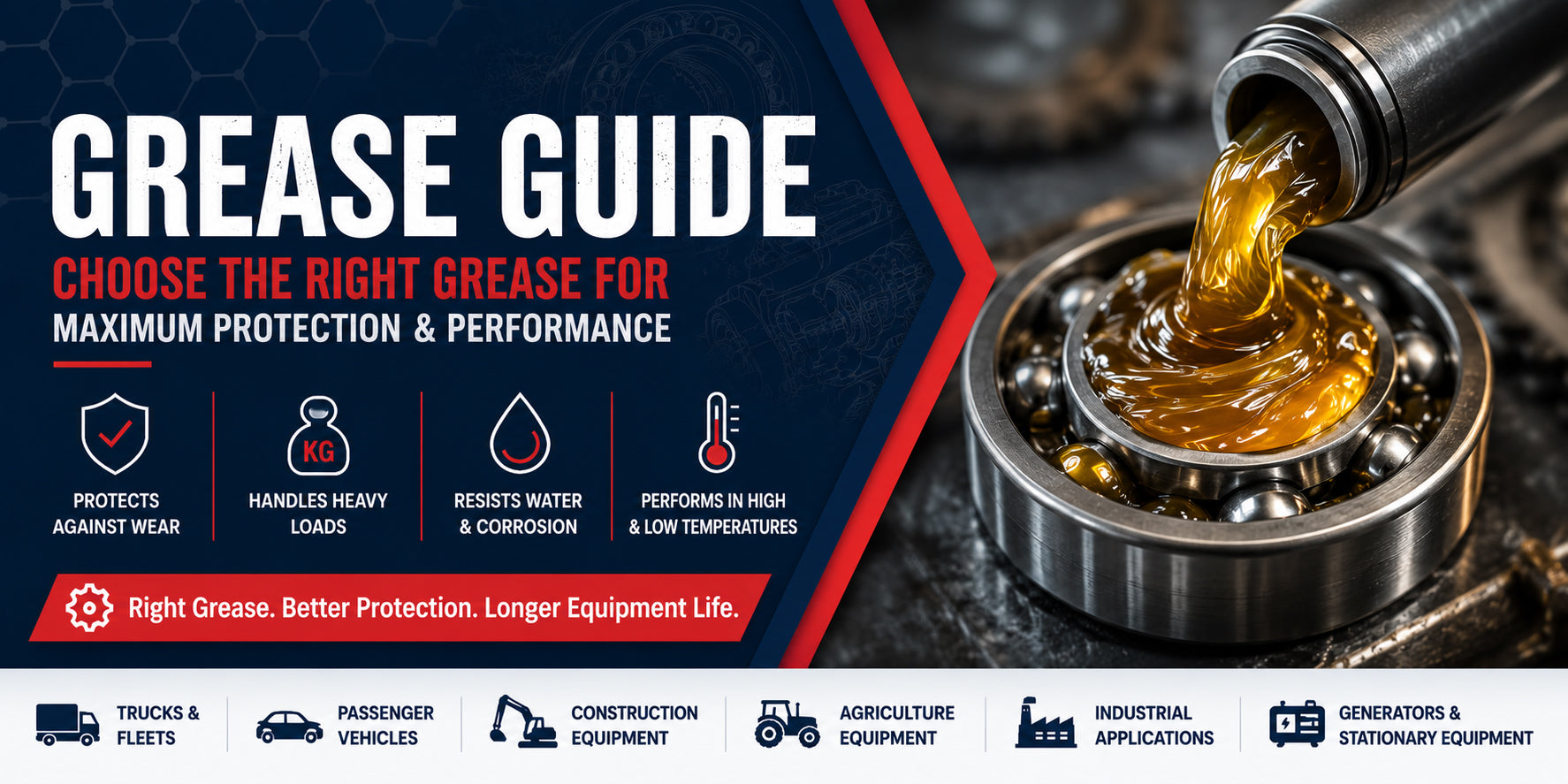
Grease Guide: How to Choose the Right Grease for Bearings, Equipment, and Heavy-Duty Applications
Grease is a semi-solid lubricant used when oil cannot stay in place long enough to protect moving parts. It is commonly used for bearings, pins, bushings, gears, chassis points, joints, and heavy-duty equipment.
The right grease depends on load, speed, temperature, water exposure, equipment type, and NLGI grade. NLGI 2 is one of the most common grease grades, while EP grease is preferred for heavy-load and shock-load applications.
What Is Grease Made Of?
Base Oil
Provides the actual lubrication between moving surfaces.
Thickener
Gives grease its structure and helps it stay in place.
Additives
Improve EP protection, rust resistance, water resistance, oxidation control, and wear protection.
NLGI Grease Grade Chart
| NLGI Grade | Consistency | Common Use |
|---|---|---|
| NLGI 000 | Very fluid | Centralized systems, enclosed gearboxes |
| NLGI 00 | Semi-fluid | Gear cases, automatic lubrication systems |
| NLGI 0 | Soft | Cold weather, centralized systems |
| NLGI 1 | Soft-medium | Low-temperature applications and some bearings |
| NLGI 2 | Medium | Most common grade for bearings, chassis, and general use |
| NLGI 3 | Firm | Applications needing thicker grease and better stay-in-place performance |
Common Types of Grease
EP Grease
EP grease contains extreme pressure additives for heavy-load, shock-load, and high-pressure applications. It is commonly used in construction, mining, industrial, and automotive equipment.
Lithium Grease
Lithium grease is widely used because it provides good mechanical stability, water resistance, and general-purpose protection.
High-Temperature Grease
High-temperature grease is designed for bearings and components exposed to heat, long operating hours, or demanding environments.
Semi-Fluid Grease
Semi-fluid grease, such as NLGI 00 or 000, is used where grease must flow more easily, such as gearboxes and centralized lubrication systems.
How to Choose the Right Grease
- Check the equipment manual for recommended grease type, NLGI grade, and performance requirements.
- Match the NLGI grade to the application. Softer greases flow more easily; thicker greases stay in place better.
- Consider load conditions. Heavy loads usually require EP protection.
- Check operating temperature. High-temperature applications need grease designed for heat resistance.
- Consider water exposure. Outdoor, marine, and washdown applications need good water resistance.
- Avoid mixing unknown greases because different thickeners may not be compatible.
Best Grease by Application
Bearings
NLGI 2 lithium or EP grease is commonly used for many bearing applications.
Pins & Bushings
EP grease is often used for heavy-duty pins, bushings, and pivot points exposed to shock loads.
Gearboxes
Semi-fluid grease may be used in enclosed gear systems where oil leakage is a concern.
Outdoor Equipment
Water-resistant grease helps protect equipment exposed to rain, mud, moisture, and washdown conditions.
Common Grease Mistakes to Avoid
Using the Wrong NLGI Grade
Too soft or too thick grease may affect lubrication performance, flow, and equipment protection.
Over-Greasing
Too much grease can increase heat, damage seals, and cause bearing problems.
Under-Greasing
Too little grease can lead to dry contact, wear, noise, and premature component failure.
Mixing Incompatible Greases
Different thickeners may react poorly when mixed, causing softening, hardening, or reduced performance.
Grease FAQs
What does EP grease mean?
EP means Extreme Pressure. EP grease is designed to protect parts under heavy load and shock-load conditions.
What is the most common grease grade?
NLGI 2 is one of the most common grease grades for general industrial, automotive, and bearing applications.
Is thicker grease always better?
No. Thicker grease is not always better. The correct consistency depends on speed, temperature, load, and application design.
Can I mix different greases?
It is not recommended to mix greases unless compatibility is confirmed.
What grease is best for heavy equipment?
Heavy equipment often requires EP grease with good load protection, water resistance, and mechanical stability.
Shop Industrial & Automotive Grease
Explore grease products for bearings, construction equipment, industrial machinery, automotive applications, and heavy-duty lubrication needs.
View Grease Products